Is your organisation ready to embrace the malaysian e-invoicing mandate?

Find the Ideal E-Invoicing Middleware Solution for You

The Bespoke Software Developer

For E-Invoicing Middleware System Customisation

Is your organisation currently utilising an ERP system such as
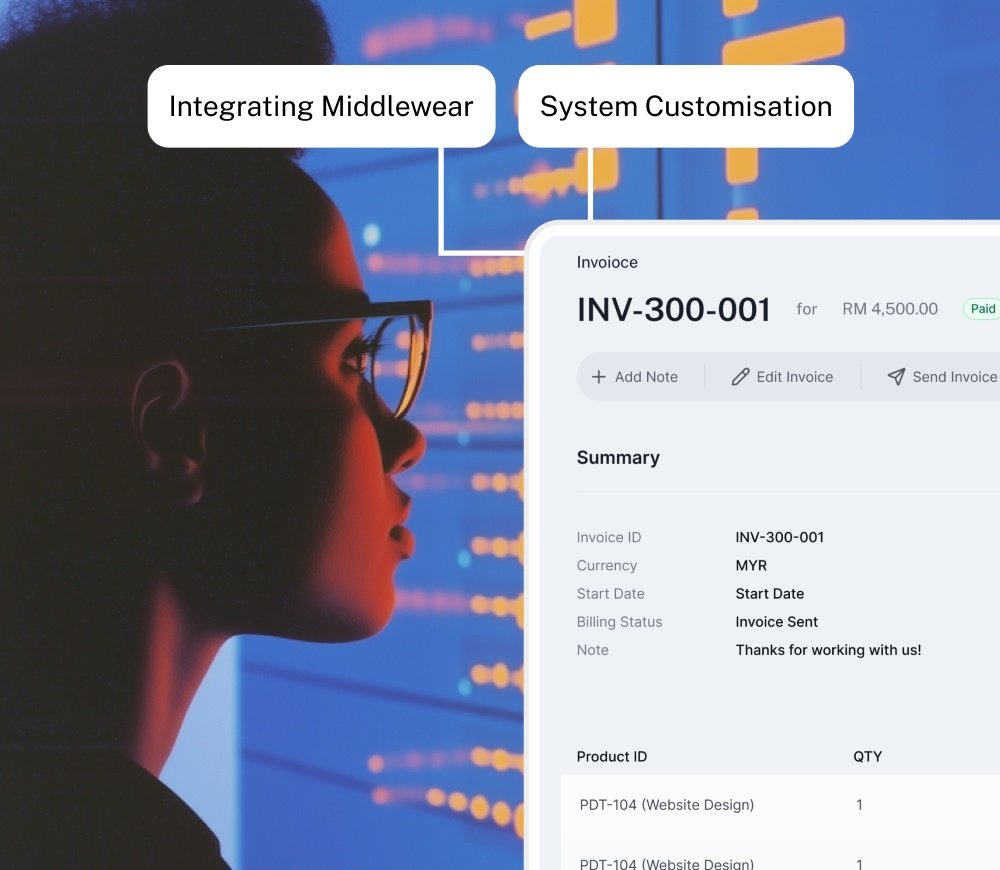
SAP, Microsoft Dynamics 365, Epicor ERP, Infor ERP, Acumatica, or Sage X3? Fret not! We specialise in customising and integrating our e-invoicing middleware with your existing platforms to ensure seamless compliance with LHDN’s mandates. Our expertise allows us to tailor our solutions to fit your specific needs, enhancing your current system without disrupting your established processes.

Government Mandated E-invoicing Adoption

Taxpayers with an annual turnover or revenue of more than RM100 million.

Phase 1 (> 100mil)

Taxpayers with an annual turnover or revenue of more than RM25 million and up to RM100 million.

Phase 2 (> 25mil)

*In December 2024 alone

Middleware Vs. Direct API

What About Directly Integrating My ERP System with MyInvois?

IT Maintenance Team

Necessitates an in-house IT or technology team to modify the ERP/business system to meet IRBM’s requirements.

Ongoing Maintenance Cost

Ongoing enhancements will be required for evolving IRBM standards, resulting in high maintenance costs from repeated system development expenses.

Each invoice sent MUST include a digital signature, which can ONLY be obtained through a Licensed Certification Authority (typically involving an annual subscription fee).


Introduction

What Is E-Invoicing in Malaysia?

E-invoicing in Malaysia is the government’s initiative to switch from traditional paper invoices to a digital format. Impacting all industries and departments such as sales, purchasing HR, operations finance and accounting. E-invoices will be used for all transactions, with the goal of improving tax administration efficiency and streamlining business processes.

E-invoicing Middleware

Our E-invoicing Middleware: Go Invoice

CognirTech’s e-invoicing middleware solution is designed to streamline your invoicing process, ensuring efficiency, reliability, and compliance, seamlessly integrated with the Inland Revenue Board of Malaysia (LHDN).

Middleware Vs. Direct API

What About Directly Integrating My ERP System with MyInvois?

API enables direct transmission of data between your ERP or business accounting system and the Inland Revenue Board of Malaysia (IRBM’s) MyInvois System for e-invoice validation which is what a middleware is. But another option is to directly integrate your existing ERP system with the Inland Revenue Board of Malaysia (IRBM’s) MyInvois System but it might not be the best option as it requires.

FAQ

Frequently Asked Questions

Answering quick questions on e-invoicing in Malaysia here. Can’t find the answer you’re looking for? Please chat with our friendly team.
What are the types of ways to ensure compliance with the LHDN/IRBM Mandated E-invocing process?
We’ve categorised 3 mechanisms to transmit e-Invoices to IRB’s database, which are as follows: MyInvois Portal (a free solution/portal hosted by IRBM) Application Programming Interface (API) Middleware However, all 3 methods will ultimately require some form of effort or cost to maintain. Read More here.
Invoice Credit Note Debit Note Refund
Ruler and Ruling Chief Former Ruler and Ruling Chief Consort of a Ruler of a State having the title of Raja Perempuan, Sultanah, Tengku Ampuan, Raja Permaisuri, Tengku Permaisuri or Permaisuri Consort of a Former Ruler of a State previously having the title of Raja Perempuan, Sultanah, Tengku Ampuan, Raja Permaisuri, Tengku Permaisuri or Permaisuri Government Government Authority Local authority Facilities provided by the above government, authority or body (e.g., hospital, clinic, multipurpose hall, etc.) Consular offices and diplomatic officers, consular officers and consular employees Suppliers who provide goods or services to the persons listed above are still required to issue e-invoices. Any entities (eg, companies, limited liability partnership, etc.) owned by the above- mentioned persons would still be required to implement e-Invoice.
Employment income Pension Alimony Distribution of dividend in specific circumstances (Refer to Section 11 of e-invoicing specific guidelines for more details) Zekat
Certain individuals and transactions are exempt from e-invoicing, including employment income, pensions, alimony, dividend distributions in specific circumstances, and Zakat payments. For full details, refer to Section 11 of the e-invoicing guidelines.

Have a potential project in mind? Let’s get discussing

Streamline your invoicing process with efficient and compliant e-invoicing solutions.